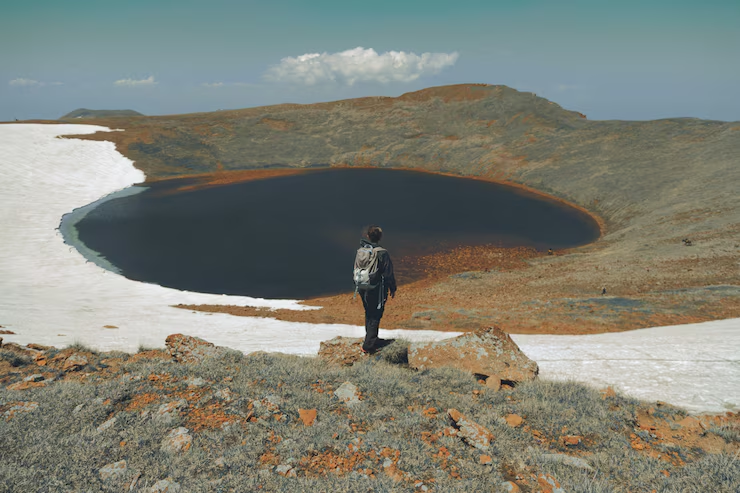


Deep in the heart of the Scottish Highlands lies Loch Neess, a serene and picturesque freshwater loch that has captured the imagination of many throughout history. But Loch Neess is not just famous for its natural beauty – it is also the home of one of the most enduring legends in the world: the Loch Neess Monster. This mysterious creature, often described as a large, serpentine or dinosaur-like beast, has been the subject of intrigue for centuries, with countless reports, sightings, and stories circulating about its existence.
The legend of the Loch Neess Monster, also known as “Nessie,” is so ingrained in popular culture that it continues to fascinate and mystify people all over the globe. But what is the truth behind the Loch Neess Monster? Is it simply a myth, a hoax, or is there something more to the mystery?
In this article, we’ll delve into the origins of the Loch Neess Monster legend, explore famous sightings and evidence, and discuss the scientific theories behind the creature. We’ll also examine the role of Loch Neess in today’s world, including the ongoing search for Nessie and the impact it has had on tourism and local culture.
1. The Origins of the Loch Neess Monster Legend
The story of the Loch Neess Monster is deeply rooted in Scottish folklore, with accounts of mysterious creatures inhabiting the loch going back centuries. However, the modern legend of Nessie can be traced to the early 20th century.
Early Reports and Folklore
The earliest mention of a creature in Loch Neess dates back to the 6th century, in the writings of Saint Columba. According to the Life of Saint Columba, an ancient manuscript, Saint Columba was said to have encountered a “water beast” while traveling near Loch Neess. The creature, described as a “water monster,” was reportedly about to attack a man who was swimming in the loch, but Columba intervened and commanded the beast to retreat. This early account suggests that creatures of a mysterious nature have long been associated with Loch Neess.
The 1930s: The Birth of Nessie
While reports of strange creatures in the loch existed for centuries, it wasn’t until the 1930s that the myth of the Loch Neess Monster truly gained widespread attention. In 1933, a local newspaper, the Inverness Courier, published an article about a sighting of a “mysterious animal” in Loch Neess. This report was followed by others, with people describing a large creature with a long neck and humps on its back. These sightings sparked a media frenzy, and the story of Nessie was born.
One of the most iconic pieces of evidence from this time is the famous “Surgeon’s Photograph” taken in 1934, which purportedly showed the Loch Neess Monster. The photograph became an iconic image of Nessie and contributed significantly to the legend’s popularity.
2. Famous Sightings and Reports
Over the years, numerous reports and sightings of the Loch Neess Monster have captured the public’s attention. While some have been debunked as hoaxes, others remain unexplained, further fueling the mystery surrounding the creature.
The Surgeon’s Photograph (1934)
Perhaps the most famous piece of evidence linking Loch Neess to the legend of Nessie is the Surgeon’s Photograph, taken in 1934 by Dr. Robert Kenneth Wilson. The photograph allegedly showed the long neck and head of a creature emerging from the water. It was published in the Daily Mail and became an iconic image of the Loch Neess Monster.
For decades, this photograph was considered the best evidence of Nessie’s existence. However, in the 1990s, it was revealed that the photograph had been staged, with the “creature” being a model attached to a toy submarine. Despite this revelation, the image remains a symbol of the Loch Neess Monster legend.
The 1960s and the Loch Neess Expedition
In the 1960s, interest in the Loch Neess Monster reached new heights, prompting scientific investigations into the loch’s depths. A major expedition in 1962, led by Dr. Neil Gemmell, involved the use of sonar technology to search for any signs of large creatures in the loch. While the expedition did not find any conclusive evidence of Nessie, it did uncover strange sonar readings, leading some to speculate that an unknown creature might inhabit the loch.
Despite the lack of concrete evidence, this and other expeditions sparked public interest in the mystery of Loch Neess and led to ongoing investigations over the following decades.
Modern Sightings
Even today, sightings of the Loch Neess Monster continue to be reported. People from all over the world visit Loch Neess in the hopes of catching a glimpse of the elusive creature. Some claim to have seen a large, dark shape moving beneath the water’s surface, while others describe seeing the characteristic humps of the creature rising above the loch.
While none of these modern sightings have provided definitive proof of Nessie’s existence, they continue to stoke the fire of mystery and intrigue surrounding Loch Neess.
3. Theories Behind the Loch Neess Monster
The question of whether the Loch Neess Monster truly exists has been the subject of debate for decades. Several theories have been proposed to explain the phenomenon, ranging from the possibility of a giant unknown creature to the idea that sightings could be attributed to misidentified animals or natural phenomena.
The Plesiosaur Theory
One of the most popular theories regarding Nessie’s origin is that the Loch Neess Monster is a remnant of the plesiosaur, an ancient marine reptile that lived during the time of the dinosaurs. According to this theory, the creature may have survived for millions of years in the deep waters of Loch Neess, isolated from the outside world.
Supporters of this theory point to the creature’s long neck and large size, which are characteristic of plesiosaurs. However, critics argue that it is highly unlikely that such an ancient creature could still be alive today, given the conditions of Loch Neess and the lack of concrete evidence.
The Giant Eel Theory
Another theory suggests that the Loch Neess Monster could be a giant eel. This theory was proposed by biologists who noted that giant eels can grow to substantial sizes, with some species reaching lengths of up to 10 feet. The idea is that these eels could be mistaken for the Loch Neess Monster when they surface or move beneath the water.
Proponents of this theory point to the fact that eels are native to the waters of Loch Neess and could potentially grow much larger than normal due to the loch’s unique ecosystem.
Floating Logs and Optical Illusions
Some experts believe that sightings of the Loch Neess Monster can be explained by floating logs or optical illusions caused by the loch’s murky waters. The loch’s unique geography and weather conditions can create strange visual effects, such as waves and reflections, which might cause people to misinterpret what they’re seeing as a large creature.
Additionally, floating debris such as logs or large branches could easily be mistaken for the humps of a mysterious creature.
4. Loch Neess Monster in Popular Culture
The Loch Neess Monster has become a global symbol of mystery and intrigue. It has inspired countless books, movies, and television shows, making Nessie one of the most famous cryptids in the world.
Films and Documentaries
Numerous films and documentaries have been made about the Loch Neess Monster, ranging from documentaries that investigate the legend to fictional movies that dramatize the mystery. Notable works include “The Loch” (2006), a documentary that explores the history of Nessie sightings, and the animated film “The Water Horse” (2007), which imagines the creation of the Loch Neess Monster legend.
Merchandise and Tourism
Nessie has also become a major part of the local economy, with various souvenirs, from plush toys to T-shirts, featuring the Loch Neess Monster. Visitors flock to Loch Neess each year to take part in guided tours, boat trips, and museum exhibits dedicated to the creature. The monster has become a major draw for tourists and has played a significant role in the region’s tourism industry.
5. The Ongoing Search for Nessie
Despite the lack of definitive evidence, the search for the Loch Neess Monster continues. Researchers and amateur cryptozoologists regularly visit the loch to attempt to capture footage, conduct sonar scans, and gather evidence that might shed light on the existence of Nessie.
Advances in Technology
Modern technology, such as underwater drones and high-tech sonar equipment, has allowed for more in-depth investigations into Loch Neess. While these efforts have not provided any concrete proof of Nessie, they have revealed fascinating details about the loch’s ecosystem and depths.
The Role of Citizens
Over the years, many individuals have contributed to the search for Nessie. Local residents, tourists, and enthusiasts often report their own sightings or attempt to gather evidence, adding to the ongoing mystery. The Loch Neess Monster has become a symbol of hope and curiosity for those who believe that the truth may one day be revealed.
Conclusion: The Loch Neess Monster – Fact or Fiction?
The legend of the Loch Neess Monster has captivated the world for nearly a century. Whether you believe in its existence or not, the mystery surrounding Nessie continues to be a source of fascination, drawing people from all over the world to the shores of Loch Neess.
While no definitive proof has emerged to confirm the existence of the Loch Neess Monster, the ongoing search, theories, and stories surrounding it ensure that the legend remains alive. Loch Neess, with its stunning natural beauty and rich history, will always be synonymous with the enduring mystery of Nessie.For those interested in the Loch Neess Monster and other Scottish legends, visit Neess for more information and resources.